

One Argo CD Hub, Many Clusters, No Tickets
At most organizations, shipping an application to an environment means a Developer files a ticket, waits for the DevOps team, then verifies. The same flow repeats for a version bump, a health check port, or a replica count. Developer waiting time and DevOps workload grow together, and together they stall delivery.
The file count grows the same way. Five clusters and twenty applications, with one hand-written Application per pair, is one hundred files that each repeat almost everything in the file beside them. Nobody did anything wrong. The cost simply multiplies.
This is the short version. I’ve written a full walkthrough of this architecture in Building a Self-Service Argo CD Architecture Across Multiple Clusters.
Five ideas
The architecture rests on five decisions, and everything else follows from them.
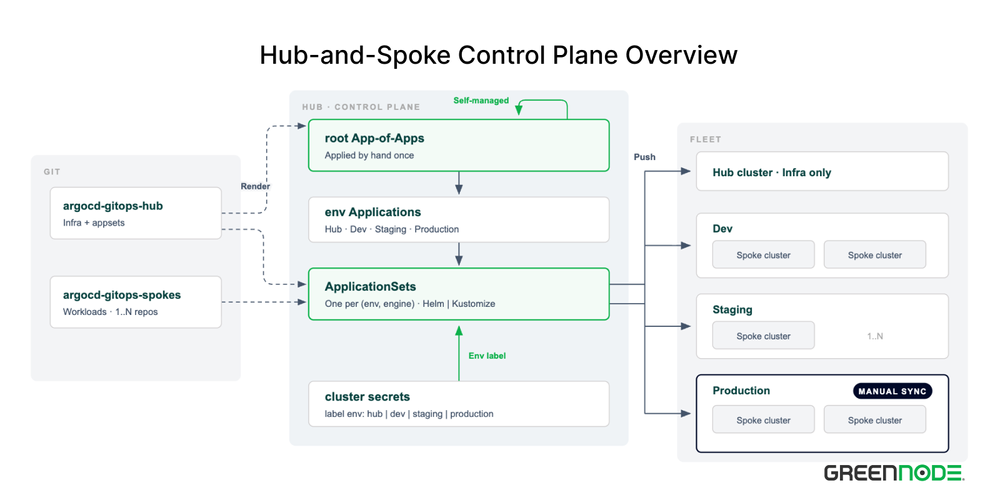
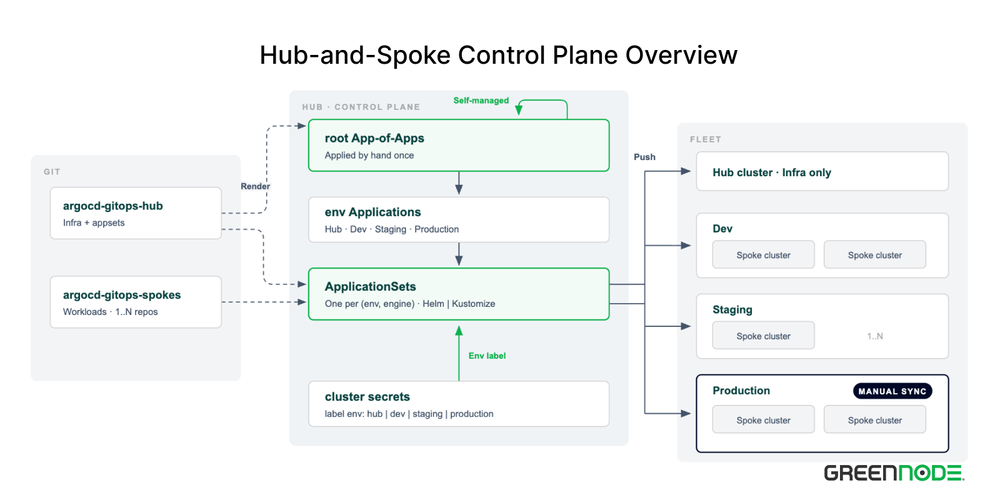
The control plane tiers. Only root-app-of-apps.yaml is applied by hand.
Hub and spoke, push model. One Argo CD on the hub cluster holds the credentials of every spoke and pushes manifests to them.
Repositories split by owner, not by environment. The DevOps team owns the hub repo, developer teams own the spoke repos, and Git enforces the boundary because write access is granted per repo.
Environments are folders, not branches. The whole fleet follows one branch, and promotion is a file copy.
Clusters are data. Each cluster is a Secret carrying labels, and
ApplicationSetjoins those labels with the matching folders to generate everyApplication.Developers self-serve. Add a folder, open a PR in your own repo, and the service appears in that environment. No ticket, no Argo CD access.
Every cell in the grid gets generated. A directory adds a column, a labelled cluster secret adds a row.
Clusters are labels, environments are folders, workloads are files, and the ApplicationSet is the engine that joins them.
What the full article covers
The write-up on GreenNode goes through the mechanism behind each idea, with the YAML to back it.
The matrix generator that joins cluster labels with
app.yamlfiles, and which template variable comes from which generatorSeven directory conventions that add an app, an environment, or a cluster without ever editing a generator
The hub and spoke repository trees, and how
AppProjectkeeps developers inside a namespaceHelm wrapper charts next to Kustomize overlays, and why Argo CD itself is the one exception
Promotion as a one-line diff, and the
valueFilesordering that makes it workThe single sync policy that separates production from everything else
Five limits of the topology, from the missing progressive sync to the hub as a single point of failure
A demo you can run yourself, where changing one label on a cluster secret rearranges the whole fleet with no file in Git changing
Read it at Building a Self-Service Argo CD Architecture Across Multiple Clusters. The code lives in argocd-gitops-hub for the control plane and argocd-gitops-spokes for the workloads.
About the author
- An engineer who just writes YAML, coding stuff, chats with AI, and spends my days making things secure, automating what I can, and debugging what I must.
Comments
Join the discussionNo comments yet. Be the first to comment.


